Melancholia
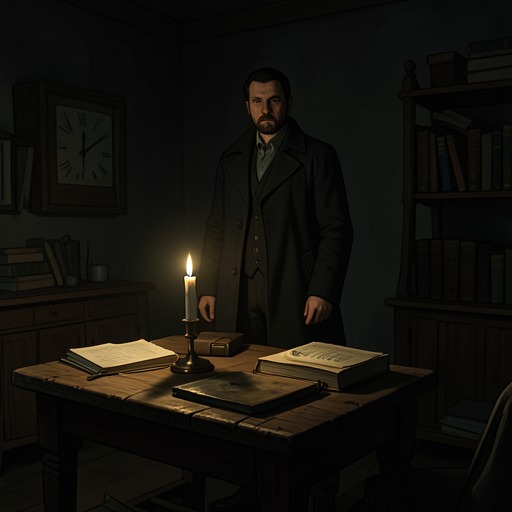
The Three MusketeersMelancholia is Athos’s recurring state of obscure, inward sorrow, the shadow that periodically falls across an otherwise extraordinary man. It is not presented as ordinary drunkenness, gambling disappointment, or present anxiety. Rather, it is a mysterious affliction rooted in the past, one that transforms Athos from a cultivated and commanding nobleman into an almost diminished version of himself while making his hidden history increasingly compelling.
Appearance and Contrasts
Athos’s melancholy is defined by a striking reversal of his normal stature. In his lucid hours he possesses the refinement of a great nobleman: he understands rank, genealogy, heraldry, etiquette, landowners’ rights, hunting, and falconry, and his education is sufficient for him to correct Aramis’s Latin. His probity is described as irreproachable. Against this background, the onset of gloom does not merely make him sad; it causes the “luminous portion” of his nature to disappear into darkness.
When the condition takes hold, Athos’s posture, face, voice, and conduct all register the change. His head hangs down, his eye becomes dull, and his speech turns slow and painful. He may stare for hours at his bottle, his glass, or at Grimaud, whose practiced obedience allows him to read even the faintest glance and satisfy Athos’s wishes by signs. Among the four friends, Athos then contributes only an occasional word, forced out with visible effort. The contrast is almost theatrical: the man who can preside over a gathering with perfect command becomes nearly silent, and the “demigod” of his brilliant self is reduced to scarcely a man.
Drinking and the Recurrence of the State
Alcohol does not cause Athos’s sadness, although it intensifies it. He drinks in an attempt to combat the melancholy, but the remedy deepens the darkness instead. Even when he drinks enough for four, wine produces no ordinary display of intoxication. Its visible effects are limited to a tighter brow and a more profound sadness, as though the alcohol exposes rather than releases the burden already within him.
The melancholy is equally distinct from the emotional volatility associated with gambling. Athos has won three thousand pistoles in a single night, lost them again down to his gold-embroidered belt, and recovered the entire sum with an additional hundred louis. None of these reversals alters his composure: his eyebrow does not rise or fall, his hands do not lose their delicate appearance, and his conversation remains calm and agreeable. Gambling therefore cannot explain the condition. Nor can it be attributed to the atmospheric influence associated with the English, because Athos’s sadness generally grows more intense during the fine season rather than during bad weather. June and July are specifically identified as his terrible months.
The Hidden Past
The most important fact about Athos’s melancholy is its unexplained origin. D'Artagnan, whose curiosity is repeatedly emphasized, has been unable to identify either the cause of the fits or the pattern governing their recurrence. Athos receives no letters and has no affairs unknown to his companions, so the ordinary signs of an active present crisis are absent. The narrative consequently directs attention backward: Athos has no current anxiety, shrugs when the future is mentioned, and leaves his secret in the past.
That past remains inaccessible because Athos’s face and speech refuse to disclose it. Even in complete intoxication, his eyes and mouth reveal nothing, however skillfully his friends question him. The melancholy therefore functions as both symptom and barrier. It visibly announces that something has happened, yet it withholds the event itself. The more impenetrable Athos becomes, the more the recurring state turns his silence into a form of narrative evidence: the hidden wound is not explained, but its pressure can be felt in the periodic collapse of his public self.
Effects on Friendship and Narrative Meaning
Athos’s melancholy also changes how his companions understand danger and loyalty. During one crisis, D'Artagnan fears that Athos may be dead and blames himself for having drawn him into an affair whose origin and outcome Athos does not know and from which he can gain no advantage. Planchet adds that the friends may owe their lives to Athos, recalling how Athos urged D'Artagnan onward while remaining behind after firing both pistols and making his sword sound as though many fighters were engaged. The juxtaposition matters: the melancholy-stricken man can appear almost inert in private, yet the same Athos is capable of extraordinary endurance and protective violence when his companions’ lives require it.
Melancholia thus gives Athos a divided dramatic identity. It is the dark counterpart to his knowledge, honor, physical mastery, and authority. The state does not erase those qualities permanently; it suspends their outward expression, allowing the novel to alternate between the polished nobleman and the silent drinker. Its recurrence also creates suspense without relying on explicit confession. Each return of the gloom recalls the existence of an unresolved past, while the failure of questions to penetrate Athos’s reserve preserves the mystery surrounding him. In this sense, melancholia is both a psychological condition within the story and a structural device through which Athos’s concealed history remains present before it is known.